Slowness and Etiquette: How Being Fully Present Is Being Well-Mannered

Updated: Apr 8
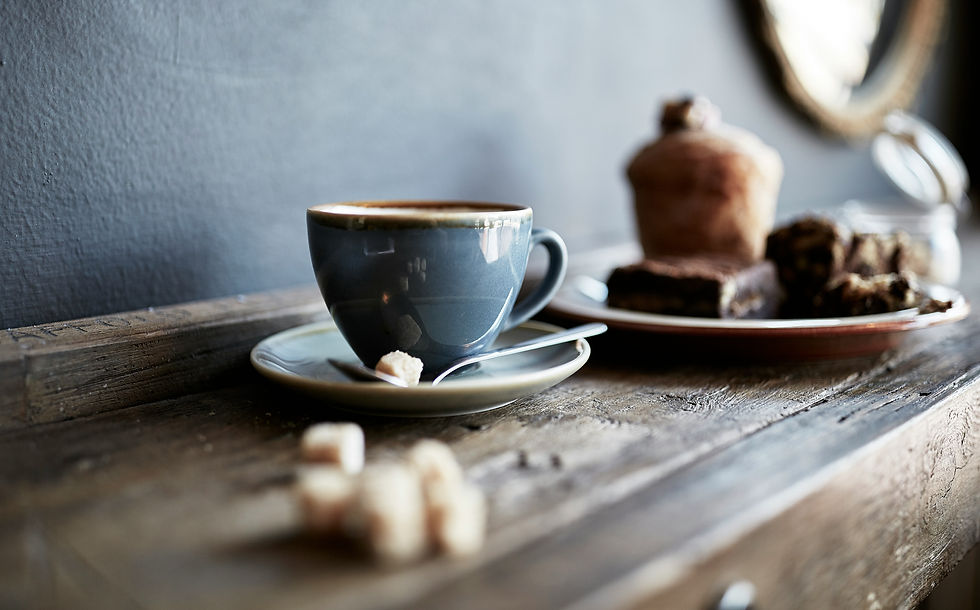
Having lived outside the Boston area for more than fifteen years hasn't come without a sharp adjustment to the fast, efficient, and sometimes frenetic rhythm of life. Coming from a laid-back Mediterranean culture — where arriving fifteen minutes late to a dinner party planned impromptu that same afternoon is actually showing up early and finding your host still at the stove, where birthday parties have no end time and a coffee meet-up lasts two hours by default — the Northeast's relationship with the clock felt, at first, inhumane and unkind.
In my culture, a play date means that mothers have coffee and home-made cake.
An invitation to a meal is reciprocated quickly - within a fortnight. Phone calls, texts, even business emails are returned within a few hours of receipt. And friends meet over a cheap bottle of wine with phones put away and eye contact so direct it feels as though your soul is being examined, read, and either redeemed or purged - over casual conversation about anything, really. Even politics. Mostly politics.
Which makes it all the more interesting that when I first moved to the United States and asked fellow Greeks how to survive — and thrive — here, the advice was unanimous: never discuss politics, religion, or education. That was good manners.
So that is what I did.
And yet my texts to playgroups went days without a reply. Business emails sometimes waited months. Dinner invitations were reciprocated after so long that I had stopped expecting them at all. Play dates received me at the door - no coffee? I would think- and parties ended promptly at three in the afternoon.
Coffee dates with new friends were scheduled a month ahead and usually involved the friend checking their phone, answering emails, taking calls — a fragmented conversation that never quite arrived at that deep cathartic feeling of being truly seen, heard, and acknowledged.
Where I come from, this reads as poor manners. Borderline rudeness, even.
But eventually something shifted in me.
No one was being rude.
They were simply moving very fast through lives that had no margins left.
The fragmented coffee date, the unanswered text, the party that ended at three — these were not failures of etiquette or social grace. They were symptoms of a culture that had confused efficiency with virtue, and busyness with self-worth. Something to commiserate over, naturally, at the much-anticipated, overly scheduled, frenetic coffee date itself.

When my oldest son was accepted into a university in the South, many people mentioned Southern manners to me. I smiled and nodded without fully understanding what they meant.
Then one morning I walked into the Nashville YMCA in typical Yankee fashion, already mid-sentence before I had cleared the door, and said: "Hi, I want to scan my national membership card, we're here for the pool." Efficient. Fast. Frantically on to the next thing.
The woman at the front desk did not respond immediately. She looked up slowly, and her hazel-honey eyes settled on me with a kind of unhurried attention I had almost forgotten existed. Then she said:
"Well, hello there. And how are you today?"
I stood there for a moment, genuinely disarmed — and then, almost immediately, embarrassed. Because in that pause — in the space between my efficient, demanding request and her quiet, humane response — I could suddenly see myself:
I had barged in. I had skipped her entirely. I had walked up to another human being and treated her like a necessity to get past on the way to where I was heading.
She wasn't being slow. She was simply refusing to skip the part that matters — the acknowledgment of a very real person before the transaction begins. And in doing so, without a word of reproach, she had held up a mirror.
I was the one with poor manners.
She was, without knowing it, practicing everything Nikki Sawhney would later put into words for me.
It was the first time I understood that etiquette is not a cultural inheritance or a regional charm. It is a choice — a small, daily act of will. And it was an understanding that would find its full articulation some time later, sitting across from Nikki Sawhney, an etiquette educator who has spent years teaching what that woman at the YMCA desk already knew by heart.

Sawhney's path to etiquette was not a straight one. A finance background, years at home raising children, and then the slow, unsettling realization that something was going wrong in the way her teenagers were moving through the world. "The tools meant to make them social were having an adverse effect on them," she says. "That's when I decided to get educated in etiquette. It's a lost art." She trained under William Hanson of The English Manner, and through the American School of Protocol and the Charleston School of Protocol, and began teaching — to schools, colleges, businesses, and the Girl Scouts. "It costs nothing," she says simply. "It's about awareness, respect, kindness, social consideration. It's about taking the time to understand the golden rule."
Ask her what etiquette is actually about — beneath the fork placement and the formal greeting — and her answer is immediate and unadorned.
"It's about relationships."
Confucius believed that ritual and propriety were the foundation of civilization itself, not mere social nicety. Sawhney thinks we have lost that deeper understanding, though not entirely. "We have reduced etiquette to surface behavior," she says, "when it was always more about character — about respect, presence, professionalism, emotional intelligence." As for when the erosion began, she pauses. Perhaps the sixties, she thinks, when tradition first came under serious questioning. And then of course the arrival of social media, which accelerated everything.
"We are constantly giving way to efficiency over presence," she says. "The foundational years are when you teach a child. You have to practice it and model it. It's not only what we say — it's how we say it."
This is where Sawhney's thinking converges with something Brené Brown has written about: the radical act of making eye contact with the cashier at a checkout line. A tiny thing. A complete thing. "Absolutely," Sawhney says. "We talk about body language, eye contact, a smile — what does it do for another person when you truly see them? If you are doing your homework and your mother walks into the room, pause, look up, acknowledge her. If you're worried about losing your train of thought, simply say: Mom, give me a moment please.
That small act makes the other person feel seen. Listen to understand — not to respond."
Her advice for anyone who wants to begin is disarmingly simple. "One interaction," she says. "Whoever that is with. Slow down. Be fully present. Pause. Notice the color of the eyes of the person you are speaking with. That's where you start. One interaction a day where you are fully present. Then grow it to two."
And slowness itself — is it a prerequisite for good manners? Can you be truly courteous in a hurry?
"Good etiquette comes from awareness," she says, "and awareness comes from attention, and attention comes from slowing down. It isn't necessarily about a slow pace — it's about unhurried attention. When we are rushing we are thinking about speed and efficiency. What we need is to be unhurried in our attention. It's less about pace and more about intentionality — about creating more moments of true attention within whatever time you have."
Unhurried attention.
The unhurried life is not, in the end, about how much time you have. It is about what you do with the space between one moment and the next — whether you rush through it or whether you inhabit it fully, turning toward whoever is there with you. It is inviting someone in for a beer or a coffee. It is tucking your phone away — all the way away — when a friend sits across from you.
It is returning the dinner invitation promptly, even if all you can offer is pasta with butter, because that was never the point. The pasta was never the point. The human contact is the point. It always was.
That turning toward another person — small, deliberate, unhurried — is courtesy in its oldest and truest form. It is what Confucius meant. It is what Nikki teaches. And it is what a woman with hazel-honey eyes demonstrated to a rushing Greek immigrant on an ordinary morning in the American South, without fanfare, without reproach — simply by refusing to skip the part that matters.
Anna Amiradaki is the founder, editor, and publisher of Khiton Free Press, a quarterly art book-quality print magazine distributed freely across Rhode Island. A multilingual communications professional with twenty years of experience, she writes about slow living, etiquette, craft, holistic wellness, and the quiet pleasure of paying attention. She lives and works on the East Bay
Nikki Sawhney is the Founder and Director of the New England School of Protocol, based in Massachusetts. She can be found at newenglandschoolofprotocol.com


Comments